

The Drum Kit That Gave Stephen Perkins a New Voice
 On 02nd Sep 2026
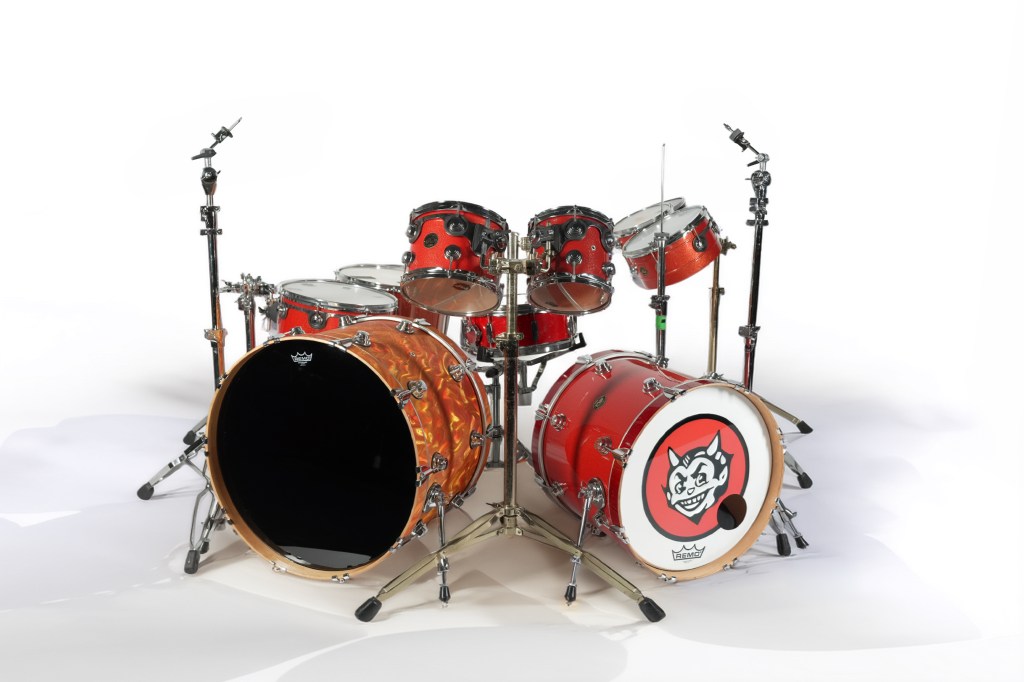
After Jane’s Addiction, Stephen Perkins wasn’t looking to repeat himself. His one-of-one 1992 DW Porno for Pyros kit became the instrument that helped him rethink his sound, translate hand percussion to the drum set, and begin again.
In 1992, Stephen Perkins found himself at one of those rare moments when a musician has both everything and nothing to prove. Jane’s Addiction had broken up. Perkins had just come off a tour with Infectious Grooves. And ahead of him was a new band, Porno for Pyros, and the opportunity to decide what his drumming would sound like when it no longer had to sound like Jane’s Addiction.
His solution started not with a beat, but with a drum set. “Brand new drum set, brand new band,” Perkins recalls. The goal he brought to DW’s John Good was unusually specific: change the sound of his drumming by changing the instruments he was hitting. That conversation produced one of the most distinctive kits in Perkins’ collection and an instrument that would become a workhorse throughout the early life of Porno for Pyros. Advertisement
Starting Over
Porno for Pyros did not begin around a conventional drum set. As Perkins remembers it, some of the band’s earliest songwriting happened with bongos between his legs and an acoustic guitar at the beach. When those ideas began making their way toward a full drum kit, he didn’t want to lose the vocabulary his hands had discovered. He wanted to translate it.
“I wanted to find those same tones and rhythms I was playing with my fingers onto the drum set,” Perkins says. That required moving away from the familiar hierarchy of kick, snare and hi-hat. Working with Good, Perkins developed a setup built around contrasting voices: 10″ and 12″ brass timbales, 10″ and 16″ maple drums, a small snare and a 20″ x 16″ bass drum. Instead of surrounding himself with conventional tom sizes, he deliberately created a palette that moved dramatically from high to low. For Perkins, that difference was the point.
The kit allowed him to approach the drums less like a traditional trap set and more like a percussionist working with a collection of distinct voices. “I tried to use the different tones of the drum set from high to low to kind of speak in tongues, in different language,” he explains. Advertisement
Finding Space in the Music
That unconventional configuration also changed the way Perkins thought about arranging his parts. With high-pitched bongos and timbales at one end of the spectrum and the larger drums providing the lows, he discovered that the kit could move in and out of a recording without constantly occupying the same sonic territory.
“When you talk about mixing a record, there’s the real estate,” Perkins says. “Who and what fits where?” The limited palette became an advantage. With fewer conventional drums available to him, every voice had a purpose. Perkins describes the result as a way to let the highs and lows “appear and disappear in the mix.” And sometimes the most important choice was not to move at all.
During the interview, Perkins recalls one performance from the record in which he resisted the busier, more conversational playing heard elsewhere and instead held a remarkably consistent groove for several minutes. He describes it as “almost a Motown pocket.” For a drummer celebrated for explosive movement around the kit, that restraint was another kind of reinvention. Advertisement
Built With John Good
The instrument itself was equally personal. Perkins’ relationship with John Good went far beyond choosing a finish from a catalog. The two would discuss the sounds, tones and notes Perkins was searching for before settling on shells and specifications.
“When I play that kit, I play differently,” Perkins says. That sentence gets to the heart of the collection. For Perkins, these drums weren’t merely tools chosen after the music had been created. The instrument could influence the music—and expose something different in the drummer playing it.
He describes the process with Good as an ongoing exchange involving woods, shell thickness, depths, edges, hoops and other variables, with each kit changing as both the technology and Perkins’ musical needs evolved. The drums would then go into studios and onto stages, effectively becoming part of an ongoing process of experimentation. The Porno for Pyros kit was an early and important example. Advertisement
One of One
Visually, there is no mistaking it. Perkins and Good called the finish Orange Flame. Orange and red were combined with crushed glass to create a sparkling effect Perkins compares to the finish of a hot rod. But the customization extended well beyond its appearance.
“Exactly, one of one,” Perkins says of the kit. The combination of color, dimensions, depths and construction choices made the instrument uniquely his. And like any instrument that actually spends its life working, it didn’t remain frozen in its original configuration. After months (and possibly years, Perkins jokes) of touring with the kit, he wanted more.
DW added an 18″ floor tom, matched as closely as possible to the existing finish, along with a 24″ bass drum covered in a psychedelic Marmalade wrap. According to Perkins, the material scratched too easily and never went into production, making that bass drum another unique element of the setup. The Porno for Pyros kit that began with one bass drum and one floor tom ultimately became a two-kick, two-floor-tom configuration. Advertisement
The Workhorse
What makes this kit important, however, isn’t its rarity. It’s what happened to it. The drums went into the studio with Porno for Pyros and then onto the road. They traveled with Perkins for years. The evidence remains on the instrument. Compared with some of the other drums in his collection, Perkins describes the kit as “fairly beat up.” It has been everywhere with him.
“That was my workhorse drum set,” he says. “Not only was it a drum set that sounded different, that stretched my imagination, but it also toured with me and the band for years.” Those marks are therefore not imperfections in the story. They are the story.
Leaving Jane’s Behind
There is another reason this particular kit carries so much weight for Perkins. It represents starting over. After everything Jane’s Addiction had accomplished, Porno for Pyros required him to step away from an established musical identity and build something new. Perkins remembers having reached a certain level with Jane’s and then realizing that a new band meant backing up and going to work again. The drum set became part of that transition. Advertisement
Touring with it was, in his words, “life-changing” not simply because it changed his playing, but because it accompanied the experience of leaving Jane’s behind and having “something fresh to break again.”
More than three decades later, that history remains embedded in the instrument. It began as an attempt to avoid repeating himself. It transformed hand-percussion ideas born during Porno for Pyros’ earliest songwriting into a new vocabulary behind the drum set. It went into the studio, onto the road and evolved as the music evolved. And most importantly, it did exactly what Perkins and John Good designed it to do. It made Stephen Perkins play differently.
From Stephen Perkins’ Personal Drum Archive
The one-of-one 1992 DW Porno for Pyros kit is part of the Stephen Perkins personal drum archive being offered through the special ArtistFirst auction on September 10 at ANALOGr.com. A portion of the auction proceeds will support the Watts Conservatory of Music. Modern Drummer will continue exploring the stories behind selected instruments from Perkins’ collection leading up to the auction. Advertisement
